A year ago, I talked to some students who had just finished their nursing training. One of them said something that struck me. He said that when he told his uncle he wanted to be a nurse, the uncle laughed. His uncle thought it was strange that a man would aspire to be a nurse. The student had done well in school and could have chosen a different career. Instead, he chose nursing.
This anecdote shows how people generally regard nursing as a profession for women, just as medicine is commonly associated with men. Professional titles such as 'sister' and 'matron' traditionally associated with the nursing profession have served to inadvertently entrench the gender profiling of nursing. A male student who chooses nursing as a career is likely to be subjected to negative comments such as, 'You are not man enough' (Chinkhata & Langley, 2018). This paper explores the historical roots of the stereotype, what the healthcare sector stands to gain by increasing the proportion of male nurses, and steps that can be taken to incentivise more men to join the nursing profession.
A Glance at the Numbers
According to the World Health Organisation's 2020 State of the World's Nursing, men constituted about 10% of the nursing workforce across the globe. In Malawi, according to Simukonda and Rapsilbern ("Anxiety in male nursing students", 1989), the recruitment of male nurses started as recently as 1985. Statistics from the Nurses and Midwives Council of Malawi (NMCM) indicate that currently male nurses constitute 30% of the total population of nurses in Malawi; in the workforce, the proportion of male nurses is a paltry 2%.
The under-representation of men in the nursing profession can be seen from the number of male students sitting for NMCM licensure examinations. In June 2025, for instance, 494 of the 1,670 candidates (30%) were male. Enrolment trends into nursing programmes are not far from this 30% benchmark. In 2026, the Catholic University of Malawi selected 84 students into the Bachelor of Science in Nursing & Midwifery; of these, 27 were male, representing 32% of the cohort. Studies across the globe have also found that the attrition rate for male nursing students is higher than for females (MacWilliams et al., "Men in Nursing," 2013).
A Brief Gendered History of Nursing
The word 'nursing' originates from the Latin verb nutrire, meaning 'to nourish', 'to suckle', or 'to foster'. The word evolved into the word norrice ('foster-mother,' used to describe someone taking care of the sick) and was later contracted to 'nurse', a term designating one who 'nourishes'. According to Marylin Klainberg ("An historical overview of nursing", 2010), the word 'nurse' also often referred to a 'wet nurse'. The feminine propensity of the nursing profession can thus be gleaned from the very etymology of the word.
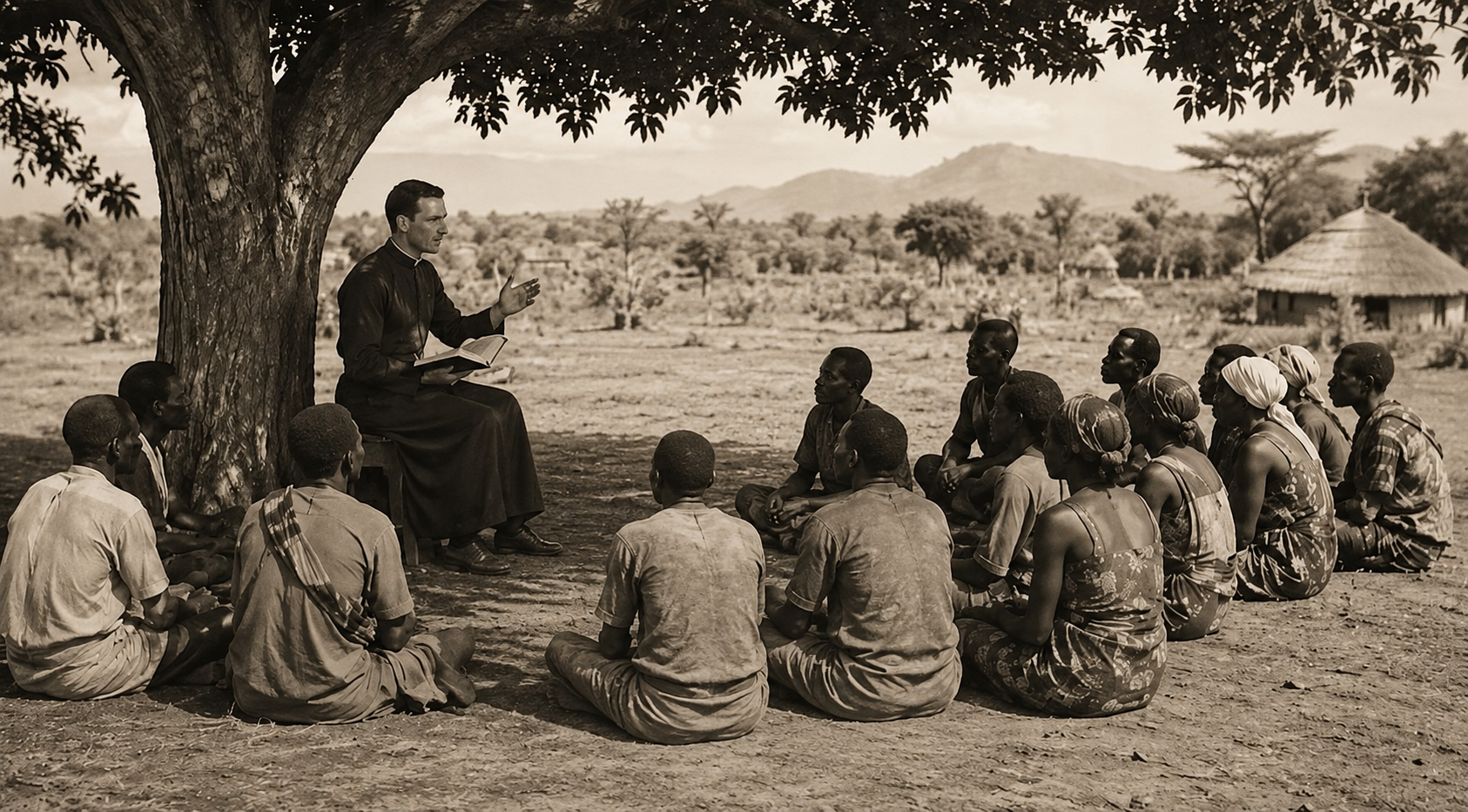
This etymology notwithstanding, in ancient society men were also active in the caring profession. The Greek word nosocomial, later Latinised as nosocomi — a combination of nosos (sick) and komein (to care) — was used for male caregivers. In pre-modern society, when care was given in the context of the household, the nursing of the sick was a shared family responsibility.
In pre-modern society, when care was given in the context of the household, the nursing of the sick was a shared family responsibility.
According to Patricia D'Antonio ("Nursing", Britannica, February 2026), in times of epidemics, men participated in caregiving. She cites the case of Stephen Girard, a wealthy French-born banker, who in Philadelphia won the hearts of many for nursing the victims of the 1793 yellow fever epidemic.
Religious orders have played an important role in the development of the nursing profession. According to Klainberg, hospes (singular hospice), centres for the care of the sick, were often located near churches or monasteries. Klainberg adds that "men were the caregivers during this time, and women were permitted to be midwives or wet nurses and were considered witches if they attempted to usurp the role of the male health-care provider" (p. 23). In the 11th century, members of the Benedictine Order cared for the sick and injured pilgrims in Jerusalem. Similarly, according to Michael Bowyer ("Nursing Before Florence Nightingale," 2025), the Order of Knights of the Hospital of Saint John of Jerusalem — commonly known as the Knights Hospitaller — cared for the injured during the Crusades. These Orders were comprised exclusively of men.
The advent of urbanisation and industrialisation of the 17th–18th centuries gave impetus to the 'professionalisation' of nursing. In response to widespread diseases stemming from poor urban sanitation, there emerged specialised caregiving centres beyond the realm of the household, where those without family members could receive health care.
The 19th century saw a significant development in the trajectory of the nursing profession, Florence Nightingale being a major actor. Coming from a wealthy British family, Nightingale defied the social convention that considered caregiving an occupation for socially marginal people. She believed that women, equipped with training in scientific principles, could significantly improve healthcare outcomes. In a social context where women did not have many career options, Nightingale was convinced that nursing could become a viable career path for women (D'Antonio, 2026). Affectionately known as the "Lady with the Lamp" on account of her nightly visits to the sick and wounded, Nightingale created a band of nurses that quickly established an enviable reputation for effective nursing practices.
Over time, hospitals run by women flourished. To strengthen the quality of caregiving, they established their own training schools. Invariably, the trainees in such schools were women, a trend further reinforced by the entry of many Catholic Religious Orders into the healthcare industry in the 20th century (J. Villa, "Catholic Orders' influence on Nursing," 2012). This, according to D'Antonio, is one of the sources of the cultural stereotyping of nursing as a profession for women.
Nursing, Masculinity and Femininity
In 1980, Geert Hofstede published a study titled Culture's Consequences, which explored differences in national culture along four dimensions: power distance, uncertainty avoidance, individualism, and masculinity. The cultural association of the nursing profession with women would suggest that nursing aligns better with femininity than with masculinity. The Bem Sex-Role Inventory (BSRI) is one of the tools used to measure the extent to which one identifies with traditional male or female sex characteristics.
On this Inventory, indicators of masculinity include leadership abilities, fearlessness, aggressiveness, ambition, competitiveness, and assertiveness, whereas femininity is measured by tenderness, compassion, understanding, humility, and sensitivity (MacWilliams, 2013; Hofstede, 1980). These characteristics influence "role strain" in nursing — that is, the extent to which someone finds it difficult to execute the roles associated with a particular job.
Studies have found that male nursing students have higher role strain scores than female students, while 'androgynous' students (those scoring high on both masculine and feminine scales on the BSRI) scored lower on role strain than those identified as 'undifferentiated' or 'feminine'. The fact that 'androgynous' students experienced lower role strain than their counterparts could point to the importance of balancing masculine and feminine characteristics in the nursing profession.
Hofstede's Masculinity cultural dimension may account for what some researchers have termed the 'glass escalator' problem. That is, men who become nurses are often moved into leadership roles quickly even though they are not fully qualified. Male nursing students are sometimes encouraged to become managers or administrators even before they have finished their training — a reflection of the assumption that men are naturally better suited to leadership roles. It is also unlikely, however, that men's promotion into administrative positions is designed to circumvent the role strain they experience in the clinical setting, especially given the lingering suspicion surrounding 'intimate touch' (MacWilliams, 2013).
Conclusion
In an age where many professions have opened up to women, the systemic roadblocks limiting men's access to the nursing career may not be necessary. Just as society has been re-socialised against associating certain professions with menfolk, it is possible to change society's perception of nursing as a job for women. The ancient Confucian principle of Ying-Yang could strengthen the balance of masculine and feminine dimensions of the nursing profession.
According to Chinese philosophy, Ying is described as a feminine principle characterised by passivity and receptivity, while Yang is a masculine principle with the dominant characteristics of activity and repulsion. The two poles of the cosmos complement each other.
Ensuring gender diversity in the nursing profession is not simply an affirmative action but also a strategy for bolstering health care — ensuring that both masculine and feminine attributes are brought to bear on caregiving.
From this perspective, ensuring gender diversity in the nursing profession is not simply an affirmative action but also a strategy for bolstering health care by ensuring that both masculine and feminine attributes are brought to bear on caregiving.