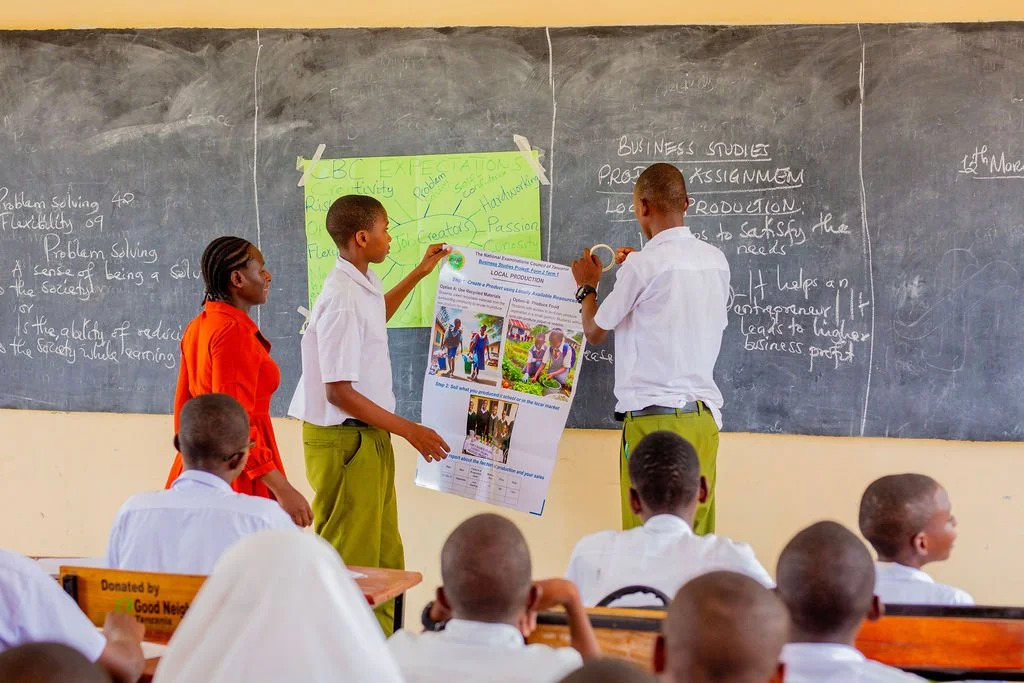
Children have a number of natural behaviours that influence the way they learn and associate with their environment. They are born naturally active, have instinctive curiosity, like playing in groups and come to school with a variety of knowledge and experiences gained from their parents, peers or siblings and different forms of gatherings (Chipeta, 1999; Samuelsson et al, 2023). These behaviours provide teachers opportunities to plan and prepare teaching and learning activities that meet learners’ natural ways of learning. It can be established that teachers can use these behaviours as resources for promoting active participation as well as meaningful learning. Therefore, it is important for teachers to understand children’s natural behaviours in order to help them plan, prepare and execute appropriate lessons and create a conducive learning environment.
Children are Naturally Active
Children are naturally active. They do not stay idle, they enjoy doing things with their hands; they also enjoy singing, dancing, observing exciting events (Chipeta, 1999). They have a desire to explore and participate in activities. Evidence shows that wherever they are, they want to touch things, observe or manipulate objects around them. In such circumstances, children learn through interaction with their physical and social environments (Pyle, et al, 2022). This is in line with Piaget’s (1952) constructivist theory that children actively build knowledge through interaction with things around them. This characteristic of children provides teachers opportunities and roles to plan teaching sessions that will perpetuate children’s natural activity other than oppressing it.
The natural activity behaviour of children provides a teacher the opportunity to use the child’s environment in using local and familiar materials as teaching materials to enhance their natural activity in learning.
United Nations Children’s Fund (UNICEF) Malawi (2022) recommends the use of local and familiar materials such as seeds, twigs, flowers, sand and charcoal to support children’s exploration and learning. In this way, the teacher has an opportunity to promote learning by “doing”. Play as natural activity is transformed into learning by doing and becomes a vehicle for conceptual learning (Pyle et al, 2022). A teacher has also an opportunity to develop independence in learners in their learning process (Montessori,1948; Deci and Ryan,2000). Since children are naturally active, a teacher can give them a chance to make decisions about their learning. For instance, on a particular topic a learner can be allowed to select methods that they would like to use, select resource materials of their choice, create questions to guide them, predict outcomes or decide ways of recording their observations. These activities also assist to build confidence in learners and at same time shift learners from passive to active acquisition of knowledge (Watts, Bentry and Hornsby,1989).
Children Have an Instinctive Curiosity
Every human being has an instinctive curiosity, and this is even truer with children. Wherever they are, they are attracted to anything that arouses their interest (Chipeta, 1999). A curious person is the one who is inquisitive and will always want to know more about their environment (Loewenstein, 1994; Jirout and Klahr, 2012; Jirout et al,2024). This behaviour provides teachers with opportunities to facilitate effective teaching and learning.
Children’s curiosity provides teachers with a variety of opportunities to use in facilitating teaching and learning process. It gives them a natural entry point into the teaching and learning process (Engel, 2011; Casey,2014). Teachers have the opportunity to build lessons based on what learners would like to know. This is revealed through the questions learners ask. The behaviour also gives teachers the opportunity to increase learner engagement in the teaching and learning process (Wang et al, 2026). When learners work on tasks that attract their attention, they are more likely to participate actively (Bruner, 1961; Piaget, 1972).
Related to the foregoing opportunity, the teachers have the opportunity of encouraging questioning during the teaching and learning process. This encourages learners to develop critical thinking and deeper understanding of the concepts being learnt (Agustini, et al, 2024). Learners’ curiosity can also promotes independent learning, for instance, by asking learners to find additional information from books or observations or through interviews while teachers become facilitators who guide learners what to do (Singh and Manjaly, 2022).
Children like Playing in Groups
By nature, children like the company of others and enjoy group activities (Chipeta, 1999). This behaviour of children is educationally relevant because it shows that learners naturally seek interaction, cooperation and shared experiences with their peers (Vygotsky, 1978; Pyle, et al, 2022).
A teacher can take advantage of children’s tendency of playing in groups to organize cooperative learning. Learners can be put in groups to work on a common task. Research reviewed by Education Endowment Foundation (EEF, 2023) shows that well planned collaborative learning can enhance effective achievement of intended learning outcomes. A teacher has also the opportunity to promote peer teaching and peer support (Vygotsky, 1978; Tenenbaum, et al,2020). A teacher can encourage learners to help and support one another when some learners have been identified to have difficulties understanding particular concepts. However, the teacher should monitor that the able learners should not do the work on their own without involving the less able. A teacher has again the opportunity to help learners develop social skills and social emotional development as they work in groups.
Group activities assist learners learn how to share responsibilities and ideas, and to take turns in speaking and listen to others.
UNICEF (2022) indicates, in a similar way, that playing together helps learners to learn how to cooperate, communicate or resolve conflicts. Furthermore, a teacher has the opportunity to help learners learn through educational games. Some learning activities can be changed into games that learners can play in groups, for instance, spelling games or role play.
Children Come to School with a Variety of Experiences
All children come to school with a variety of experiences obtained from their parents, peers, play and every day activities
(Moll et al, 1992)
No child comes to school empty headed. Therefore, teachers can link these experiences with new concepts to be taught to make learning meaningful (Chipeta, 1999). It is important therefore for teachers to use this tendency of children to facilitate effective teaching and learning process.
A teacher has the opportunity to identify prior knowledge on a particular topic and link it to the new knowledge of the same topic. This allows learners to learn from known to unknown to build concrete blocks of knowledge in their cognitive structure (Ausubel,2000; Novak,2002; Bryce and Blown, 2024). Learners can give appropriate examples from their experiences. Such approach allows a teacher to make lessons relevant to learners’ everyday lives. A teacher has also a chance of enhancing learner participation by encouraging learners to share their experiences on a particular topic being taught through discussions, demonstrations, role-play or storytelling (Boheim, et al, 2023). This makes the class more learner-centred where learners actively contribute to the learning process. Tapping into learners’ prior learning also allows the teacher to correct misconceptions. Teachers should therefore first identify and correct learners’ misconceptions before introducing new concepts. This is vital because prior knowledge can either support or interfere with the acquisition of new knowledge (Bransford et al, 2000).
Conclusion
Beliefs about children’s behaviours that they are naturally active, that they have instinctive curiosity, that they like playing in groups and that they come to school with a lot of knowledge and experiences provide teachers with opportunities to plan and make lessons relevant, engaging, practical and meaningful. These tendencies act as entry points for teaching and learning processes, therefore, they really influence effective teaching and learning processes.